Effects pedals transform your guitar tone, from subtle enhancement to complete sonic reinvention. Understanding different effect types and how they interact helps you build a pedalboard that expresses your unique musical voice.
Overdrive and Distortion
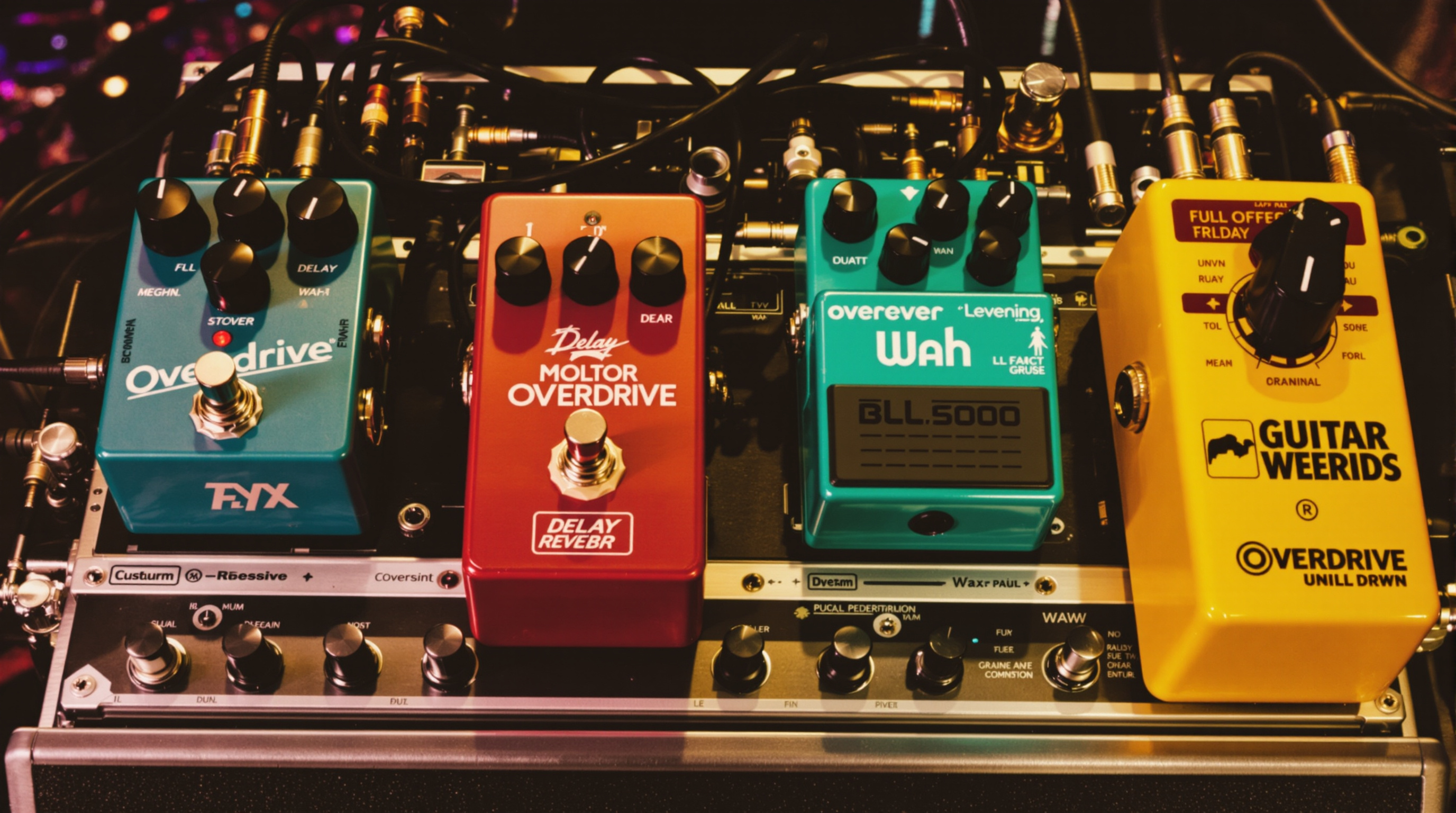
Overdrive and distortion pedals add gain and grit to your signal. Overdrive pedals simulate the natural breakup of a tube amplifier pushed into saturation, offering touch-sensitive response. Classic examples include the Ibanez Tube Screamer and Boss BD-2 Blues Driver.
Distortion pedals provide more aggressive clipping and sustain, essential for rock and metal. Fuzz pedals offer vintage, woolly distortion with extreme harmonic content. Many players stack multiple gain pedals for tonal variety.
Delay and Echo
Delay pedals repeat your signal after a specified time, creating echoes that range from slapback (short, single repeats) to ambient washes (multiple, long-tailed repeats). Analog delays offer warm, degrading repeats, while digital delays provide pristine, infinite-repeat capabilities.
Features to consider include tap tempo (setting delay time by tapping), modulation (adding movement to repeats), and stereo outputs for wider soundscapes. The Boss DD series and TC Electronic Flashback are popular choices.
Reverb
Reverb simulates the natural reflections of acoustic spaces, from small rooms to vast halls and ethereal shimmer effects. Spring reverb recreates classic amp sounds, while plate reverb offers smooth, even decay. Modern pedals include hall, room, chamber, and ambient algorithms.
Reverb adds depth and atmosphere to your sound, making notes feel more alive and connected to a space. Too much can muddy your tone, so use reverb thoughtfully in the context of your overall sound.
Modulation Effects
Modulation effects add movement and texture to your sound. Chorus creates shimmering, doubled tones by mixing slightly detuned copies of your signal. Phaser sweeps a notch filter through your frequency spectrum. Flanger produces jet-like whooshing effects through comb filtering.
Tremolo modulates volume for pulsing effects, while vibrato modulates pitch. Rotary pedals simulate Leslie speaker cabinets. Dunlop, Boss, and MXR offer classic modulation pedals.
Wah and Expression
Wah pedals enable expressive frequency sweeps controlled by a foot treadle, essential for funk, rock, and blues lead work. The Dunlop Cry Baby and Vox wah pedals are industry standards.
Expression pedals control parameters on other effects in real-time, such as delay mix, reverb depth, or pitch shift amount. Auto-wah (envelope filter) pedals respond to your playing dynamics instead of foot control.
Building Your Pedalboard
Traditional signal chain order places tuner first, then wah, compression, overdrive/distortion, modulation, and finally delay/reverb. However, experimentation often yields creative results - there are no absolute rules.
Start with essential effects for your style and add gradually. A quality overdrive, delay, and reverb cover many musical situations. Consider power supply quality, cable quality, and board organization as your collection grows.
Power Supplies and the Hum You Cannot Find
Most mysterious pedalboard noise is a power problem rather than a pedal problem. Daisy-chaining several pedals from one unregulated supply ties their grounds together and produces a hum that follows you from venue to venue and disappears the moment you plug the offending pedal in on its own. An isolated-output supply gives each pedal its own electrically separate feed and removes the whole class of fault. Check current draw as well as voltage: digital delays and reverbs can draw several hundred milliamps, and a supply that is comfortably within spec on paper will misbehave under load in ways that look like a failing pedal.
True Bypass, Buffers and Long Cable Runs
True bypass is widely treated as automatically superior, which is a simplification. A chain of true-bypass pedals connected by long cables presents a substantial capacitive load to the guitar's pickups, and the audible result is a loss of high end when everything is switched off — the tone suck players usually blame on the pedals themselves. A single good buffer, placed early in the chain, drives that cable capacitance and restores the top end. The exception worth knowing is a vintage-style fuzz, which wants to see the pickups directly and can behave strangely after a buffer; if you run one, put it first.